Tree Pruning & Trimming in Wellington
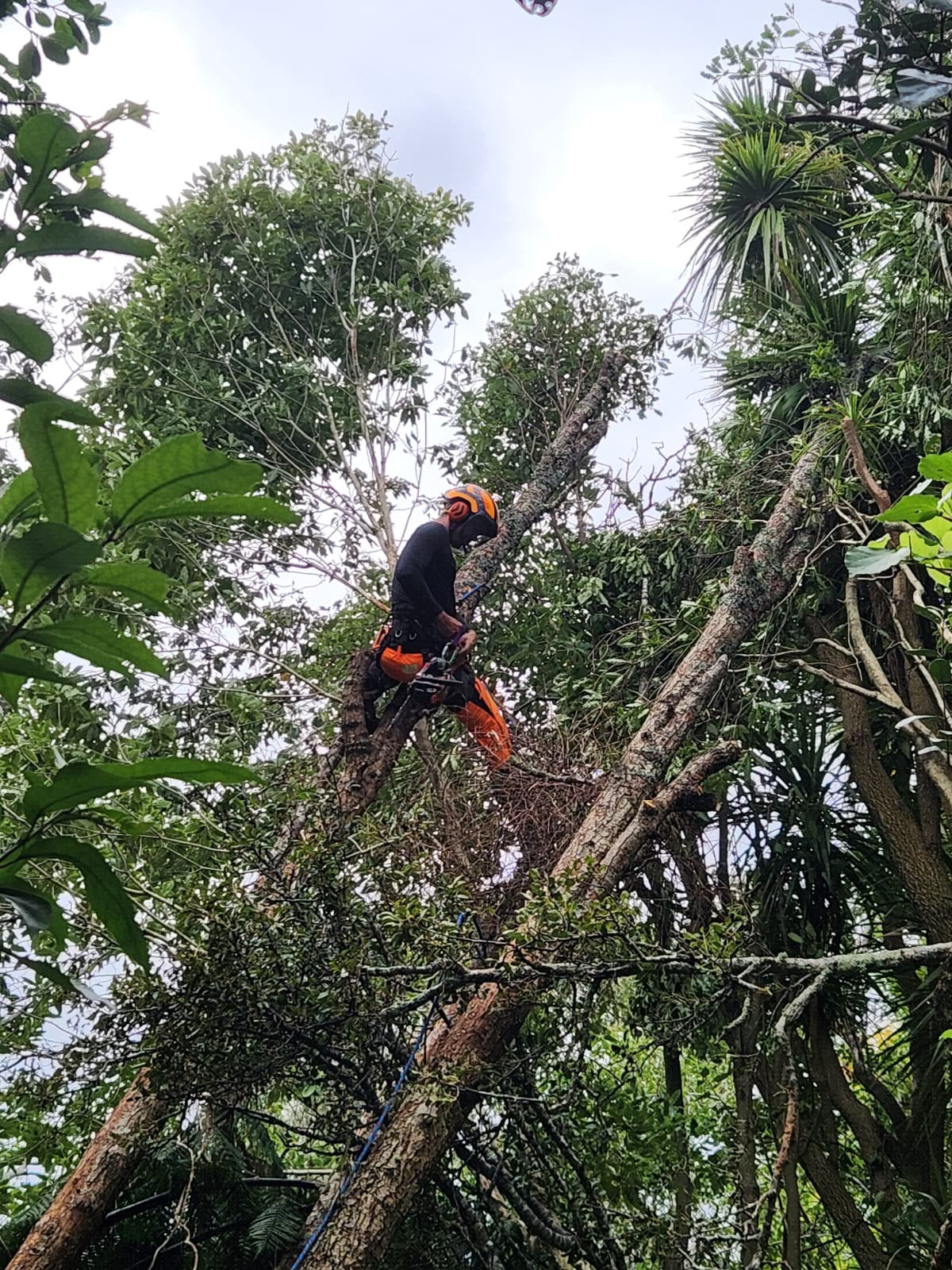
Wellington's trees mostly aren't the problem; the site around them is. A tree that would be a straightforward prune anywhere else can mean working off a retaining wall, lowering branches down a flight of steps, or cutting back growth that's already close to an overhead line. Prana Tree prunes and trims trees across Wellington City using climbing and rigging, with a free, no-obligation on-site quote to start.
We're based on the Kāpiti Coast and work throughout Wellington City as part of our wider service area.
Why Pruning Is a Wellington-Specific Job
A lot of pruning advice online is generic, the same crown-reduction explanation whether the tree is in a flat suburban backyard or on a near-vertical section above a retaining wall. Wellington's actual pruning jobs are shaped by three things most of that advice ignores: steep, access-limited sections where there's often nowhere to park a vehicle let alone position equipment; genuinely strong, scheduling-relevant wind; and a dense network of overhead lines running through mature, close-set residential streets. We'll come back to each of these below, because they change how a job is actually done here, not just what it's called.
If a tree can reasonably be kept with the right pruning, we'll say so rather than suggesting removal is the easier path. That's the starting point of every assessment, not a line we use when convenient. Where a tree genuinely can't be kept, that's what our Wellington Tree Removal page covers.
Pruning Services We Provide
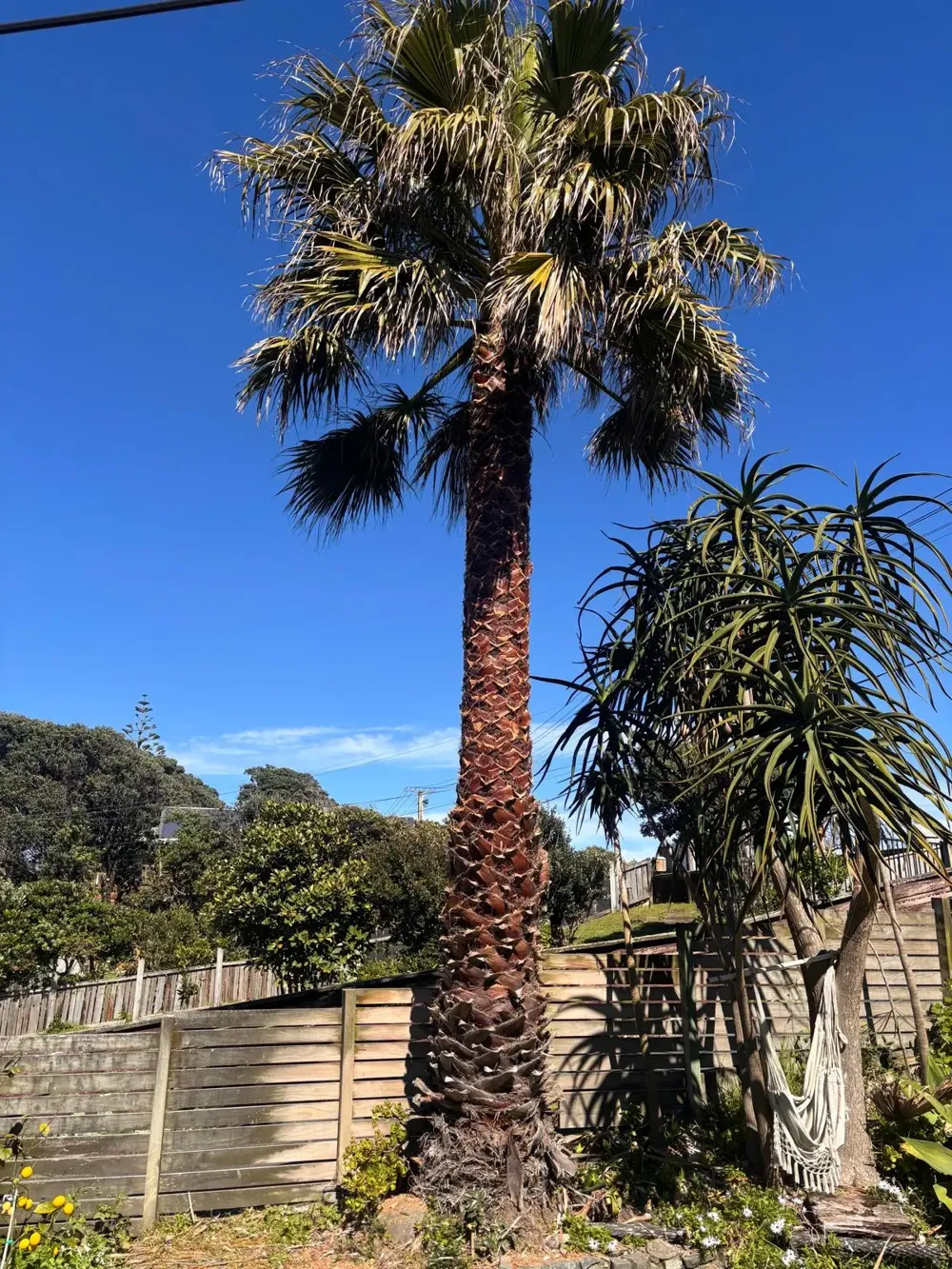
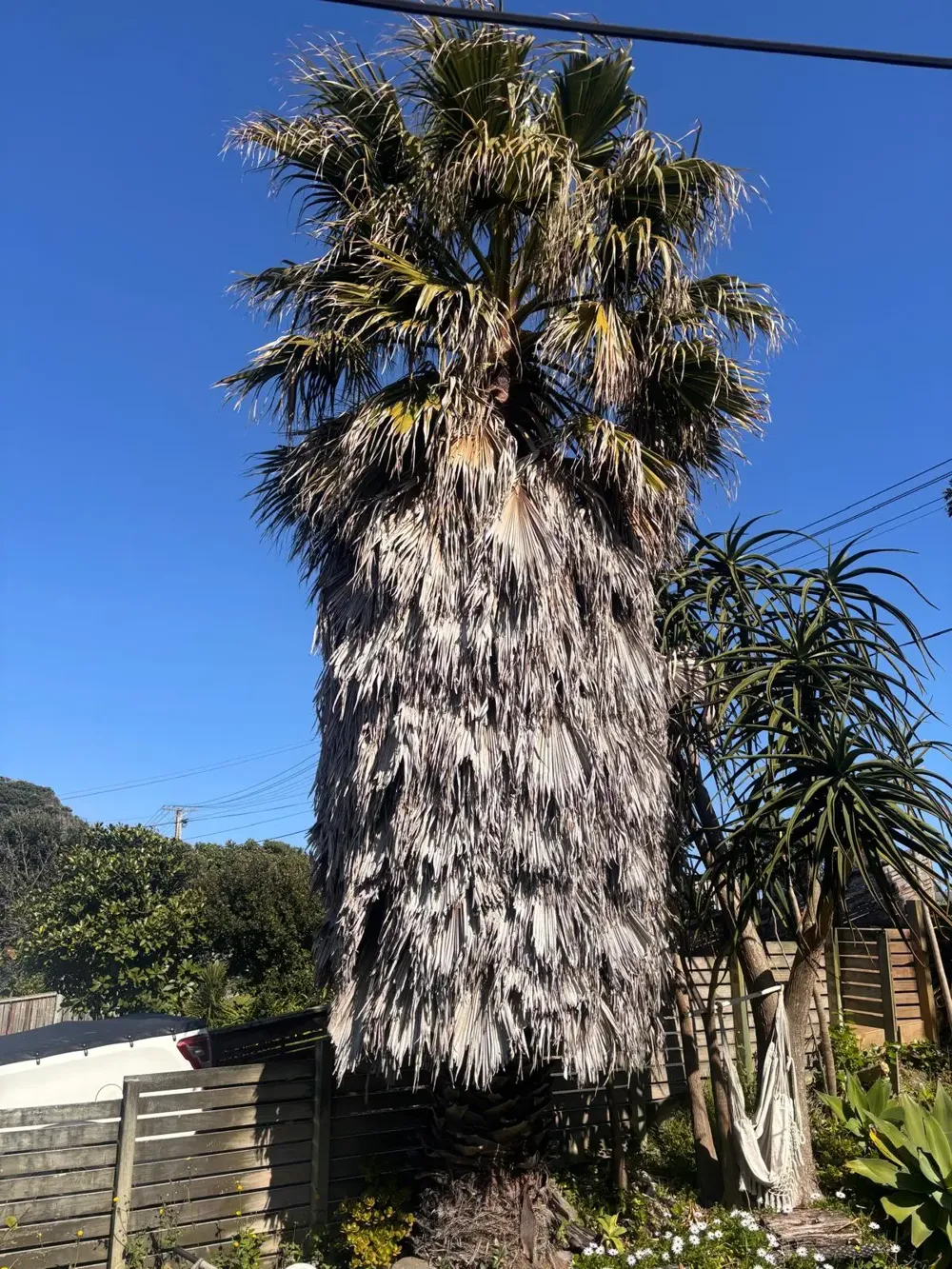
Drag the slider to compare a palm before and after a full clean-up of its dead fronds.
Crown Reduction
Reduces a tree's overall height and spread while keeping its natural shape, cutting back to suitable lateral branches rather than leaving stubs. Used when a tree has outgrown its space, or to reduce wind-loading on an exposed canopy, relevant on a lot of Wellington's wind-exposed sites.
Crown Lifting
Removes the lowest branches to raise the canopy, creating clearance underneath. Useful where a tree overhangs a driveway, path, deck or roofline, or where branches are starting to touch a structure.
Crown Thinning
Selectively removes a portion of the inner growth to let more light and wind pass through the canopy without changing its overall size. Genuinely useful for two different Wellington problems: letting more wind pass through a dense, top-heavy canopy on an exposed site, and letting more light reach a section that's shaded by a neighbouring tree.
Deadwooding
Removal of dead, dying and diseased branches. Addresses the most common safety concern we're called out for, a limb that looks wrong, or deadwood sitting over a path, deck or parked car, without touching the tree's healthy structure.
Formative Pruning
Structural pruning of young trees to establish a sound framework early, correcting weak attachments before they become a problem later. The highest-value pruning there is, because it prevents faults that are far more costly to fix once a tree is mature.
Not sure which of these your tree needs? That's what the on-site assessment is for. For broader questions about pruning technique and timing that aren't specific to Wellington conditions, our general Tree Pruning & Trimming page covers that ground in more depth.
Why We Don't Top Trees
Topping, cutting a tree's main stems back to stubs, is still offered by some providers in the Wellington area, and it's poor practice. Cutting into stubs leaves wounds a tree can't seal properly, which opens the way for decay. The tree responds with a rush of weak regrowth attached only to the outer wood, regrowth that's more likely to fail in wind than the branches it replaced. On an exposed Wellington site, that's a genuine liability, not just an aesthetic issue.
If a tree needs to be smaller, a properly executed crown reduction achieves that without the damage. If a tree is so oversized that only topping would fix it, that's usually a sign it's the wrong tree in the wrong place, worth an honest conversation rather than a quick fix that creates a bigger problem in a few years.
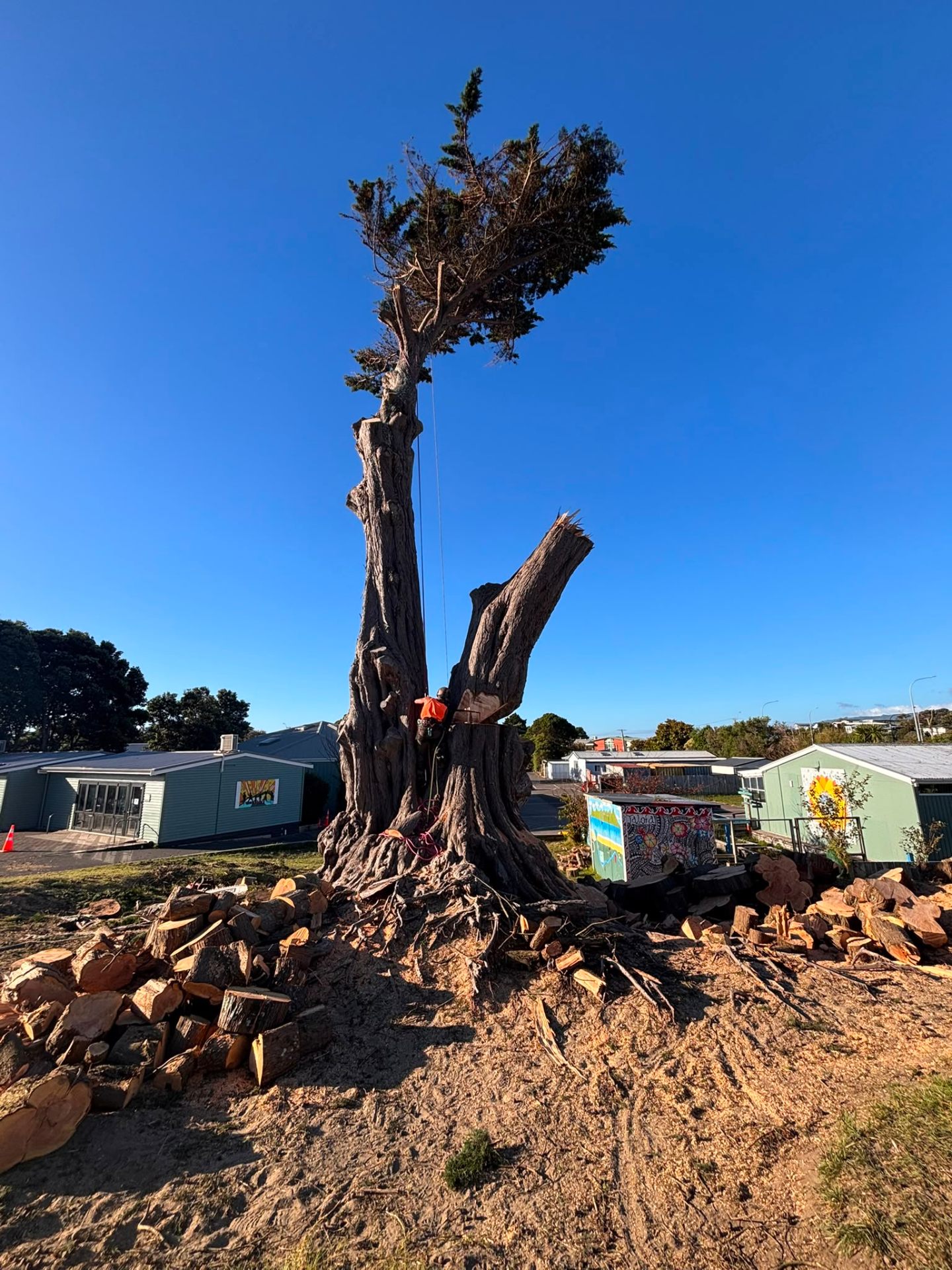
Pruning on Wellington's Steep and Access-Limited Sections
A large share of Wellington properties are built on a slope, terraced, stepped, with houses sitting above and below each other and very little flat ground anywhere near the tree. That changes how a pruning job is actually carried out.
Limited or no vehicle access.
Steps instead of a driveway, a narrow path, a shared right-of-way, or no way to get a vehicle anywhere near the tree. We plan for this at the quote, how the crew and gear get in, and how pruned material gets back out when there's no truck parked next to the tree.
No real space to work equipment-based.
On a lot of these sites there's nowhere flat enough or close enough to position a platform or lift, even where one might otherwise be useful. Climbing and rigging isn't a fallback here; on a genuinely constrained site, it's usually the method that actually works, because it doesn't need ground space to operate from.
Material has to be lowered, not dropped.
With houses, fences and gardens close on every side, pruned branches are cut in manageable sections and lowered under control with rigging, so nothing lands where it shouldn't. On a stepped site, that sometimes means carrying material out by hand rather than loading a chipper right at the tree.
Boundaries sit close.
Small sections mean a Wellington pruning job often means working directly above a neighbour's roof, fence or garden rather than open lawn. Protecting what's below, and what's next door, is planned for before the climb starts.
Trees Near Power Lines
Trees growing close to overhead lines are a regular reason people in Wellington contact us, and it's worth understanding the basics before you call anyone.
Under New Zealand regulation, trees are required to be kept clear of defined zones around power lines, and that responsibility sits with the tree owner, not the lines company. Where a tree has encroached far enough, the lines company can issue a formal notice requiring the growth to be cut back, and in that situation, the first cut is generally carried out at the lines company's expense, with responsibility for keeping the tree clear afterwards passing to the owner. Only suitably authorised people may work within the minimum approach distance of a live line, and that distance varies depending on the line itself.
Our work in this situation is on the tree, pruning back vegetation to restore and maintain clearance, not on the electrical network. In Wellington City and the Hutt Valley, the lines company is Wellington Electricity. If you've received a notice, or you think a tree on your property might be encroaching, that's the right first call to make, and we'll talk through what's involved at the assessment.
Light, Shade and Boundary Trees on Stacked Sections
Because so many Wellington properties sit above or below their neighbours, a single tree can shade an entire section that isn't even the one it's growing on. This comes up often: a tree blocking light into a house, overshadowing a deck, or sitting between two properties where one owner wants it reduced and the other doesn't want it touched.
Crown thinning and crown reduction can genuinely improve light without removing the tree. We'll talk through what's realistic for your situation at the assessment, including whether the result is likely to meet expectations before any cutting starts. Where a tree sits on or near a boundary and the question is really about who's responsible for it or what either neighbour can do about it, that's a conversation worth having directly with your neighbour first; we can prune the tree properly once that's sorted, but we're not in a position to resolve a boundary disagreement for you.
Wind and Why Timing Matters Here
Wellington is genuinely one of the windiest cities in the country, and for pruning specifically that matters in two ways. First, a well-thinned canopy carries less wind load than a dense, top-heavy one; crown thinning and sail-area reduction are legitimate ways to manage a tree's exposure, not just aesthetic choices.
Second, aerial pruning work depends on safe conditions, so on a genuinely windy day, climbing work sometimes has to wait. We'd rather reschedule than take an unnecessary risk, and that's factored into how we plan a job here rather than treated as an excuse when it comes up.
We also keep nesting birds in mind when timing heavier canopy work. Disturbing the nests of native birds is an offence under the Wildlife Act, so where possible, significant pruning is planned outside peak spring nesting and canopies are checked before work begins.
What Affects the Cost
There's no set price for tree pruning, and on Wellington sites, access usually affects the cost as much as the tree itself. What changes it:
Size and the type of pruning required
deadwooding is quicker than a full crown reduction
Access
whether the crew and equipment can reach the tree directly, or whether everything has to be carried in and material carried back out
What's underneath and around the tree
pruning over a roof, deck or close boundary takes longer and more careful rigging than pruning over open ground
Volume of material
how much there is to lower, process and remove
Site conditions on the day
wind can affect scheduling as much as it affects the method
Rather than quote a figure that wouldn't fit your actual site, we assess in person, for free, and provide a clear written quotation based on the work required.
Book a Free On-Site QuoteOur Process
1. Get in touch
Tell us about the tree and the site by phone, WhatsApp or the enquiry form.
2. Free on-site assessment
We look at the tree and the access properly, explain what pruning can and can't achieve, and talk through the options honestly.
3. Clear written quotation
You receive a clear written quotation based on the actual work required, with no obligation to proceed.
4. The work, done properly
Pruning is carried out by qualified arborists using climbing, rigging and appropriate cutting techniques, planned around your site's access and conditions.
5. Full clean-up
Every job finishes with a complete site clean-up. Material is lowered, processed and removed, or left as mulch or firewood where that suits you better. See our Green Waste Removal & Mulching page for more.
Residential, Commercial and Body Corporate Pruning
We prune for homeowners across Wellington, as well as property managers, body corporates, schools, and commercial and retail properties. Wellington's apartment and townhouse density means a fair amount of our enquiries come from body corporates managing trees across a shared site rather than a single owner managing one tree; the same honest, assessed approach applies either way. For properties needing a regular, planned schedule across a larger site, see Commercial Tree Maintenance.
Qualified Arborists, Fully Insured
Our arborists hold NZQA Level 4 Arboriculture qualifications, with chainsaw competency, climbing experience and relevant health and safety training. Our work is fully insured, including public liability. You deal directly with Alejandro from your first enquiry through to the job being finished.
Where We Work
Prana Tree is based on the Kāpiti Coast and provides tree pruning and trimming throughout Wellington City, alongside our work across the wider region: Porirua, the Hutt Valley, and Levin. See all our service areas, or get in touch and ask.
Frequently Asked Questions
What's the difference between pruning and trimming?
In everyday use they mean much the same thing. "Trimming" tends to describe lighter tidying-up work, while "pruning" covers the full range, including structural and health-driven work. Either way, the right cuts in the right places are what matters.
How much can safely be pruned off a tree?
It depends on the species, its age and condition, and what the pruning is trying to achieve; there's no fixed percentage that applies to every tree. Removing too much at once stresses a tree and can trigger exactly the kind of weak regrowth that proper pruning is meant to avoid. We'll talk through what's reasonable for your specific tree at the assessment.
Will pruning damage my tree?
Correct pruning won't; it's one of the best things you can do for a tree. Over-cutting, topping and stub cuts cause decay and weak regrowth. The safeguard is having the work done by someone qualified who removes only what needs to go.
Why won't you top my tree?
Topping leaves large wounds that don't seal properly and triggers weak, densely packed regrowth that's more likely to fail in wind than the growth it replaced, a real concern on an exposed Wellington site. If a tree genuinely needs to come down in size, a proper crown reduction achieves that without the long-term damage.
Can you prune a tree near power lines in Wellington?
Often, yes, within the limits the regulations allow. Keeping a tree clear of lines is generally the owner's responsibility, and only authorised people can work within the minimum distance of a live line. If you've received a notice from Wellington Electricity or think a tree may be encroaching, let us know at the assessment and we'll explain what applies to your situation.
Do you need council consent to prune a tree in Wellington?
For most ordinary trees on private property, no, but it can depend on whether the tree is listed as notable or scheduled by Wellington City Council, or is within a heritage area. If you're not sure whether that applies to your tree, it's worth checking directly with the council before assuming either way.
Can you work on a steep section with no vehicle access?
Yes, this is one of the most common site conditions we work with in Wellington. We plan for it at the quote, including how material gets off the site when there's no vehicle access nearby.
Does wind affect when you can work?
Yes. Aerial pruning depends on safe conditions, and Wellington wind is a genuine factor. If a day isn't safe for climbing work, we'd rather reschedule than take a risk.
How much does tree pruning cost in Wellington?
It depends on the size of the tree, the type of pruning, and access, which on a lot of Wellington sites has as much impact on the cost as the tree itself. The on-site assessment and quotation are free, with no obligation.
Do you do regular or scheduled pruning?
Where ongoing maintenance makes sense for a property, we're happy to discuss a suitable approach with you. It isn't a fixed contract by default, but something worked out to fit the site.
Request a Free On-Site Quote
Whether it's a single tree overhanging a path, a tree encroaching on a power line, or a tree that's simply outgrown a tight Wellington section, start with a free, honest on-site assessment. We'll tell you what the tree actually needs and give you a clear quote.
Or call 021 626 507 / message us on WhatsApp.